Zone 3
Hardy, wild, and vivid

This month’s newsletter is free for all subscribers. I’m focusing your attention to one journal in this very hot July: the nationally distributed Zone 3, by Austin Peay State University’s Center for Excellence for the Creative Arts, in Clarksville, Tennessee.
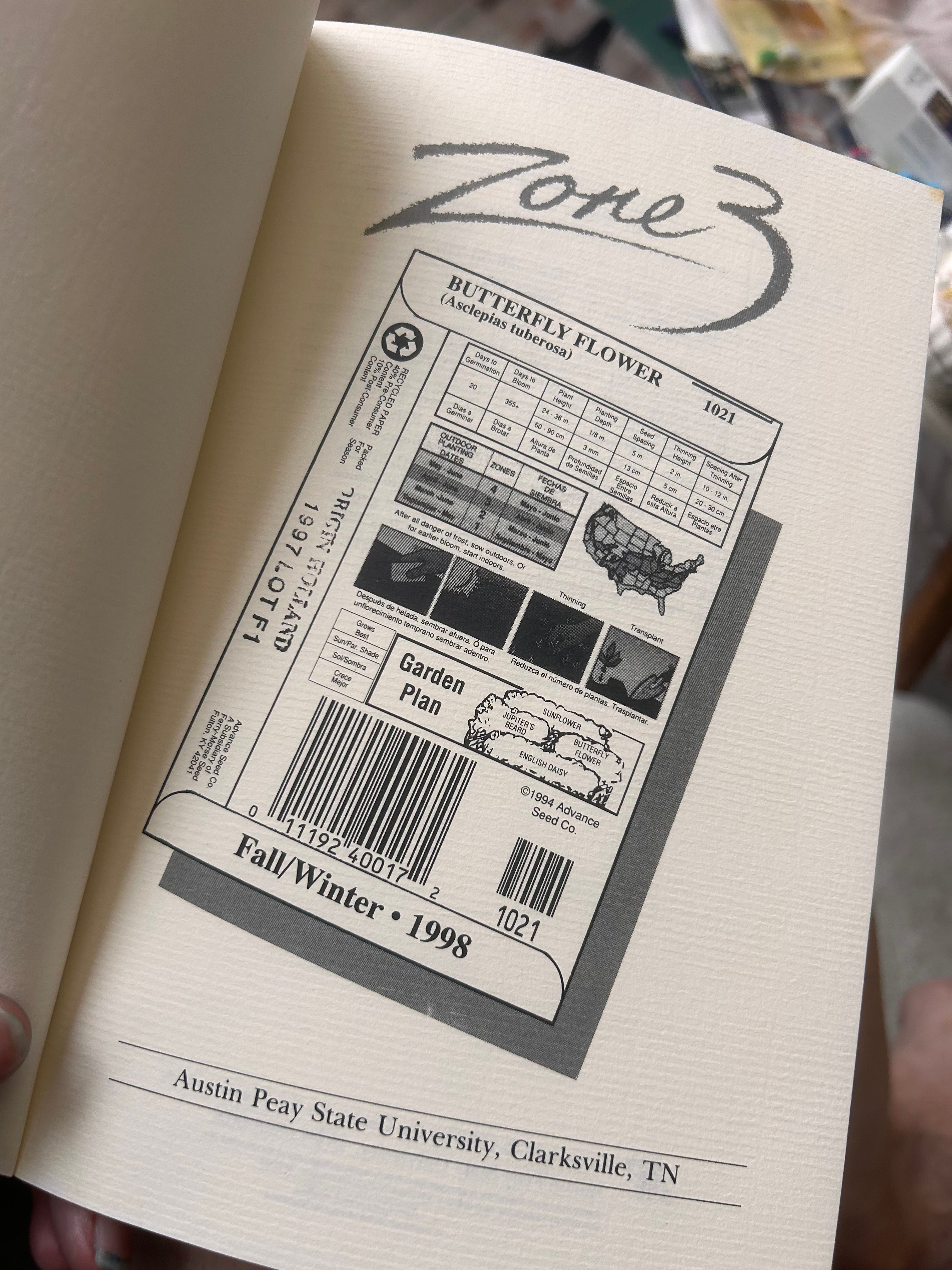
Zone 3 was founded by David Till and Malcolm Glass, in 1986, as a print poetry journal with card cover that featured a poem on the front. Zone 3 refers to seed packet growing zones, and the placement of Clarksville in one with harsh winters and short growing seasons, where trees thrive, peonies, and juniper. The original editor’s note included this language: “What roots and blossoms here might survive anywhere, or nowhere else at all half so well. And what roots and blossoms elsewhere in native profusion might, like kudzu, take hold here—bring an end to erosion, or choke the forest. ZONE 3 seeks to be a ground where these things are tested…” I had a skateboarding poem in the Fall/Winter 1998 issue. Each issue back then included a graphic of a zone 3 seed packet, such as:
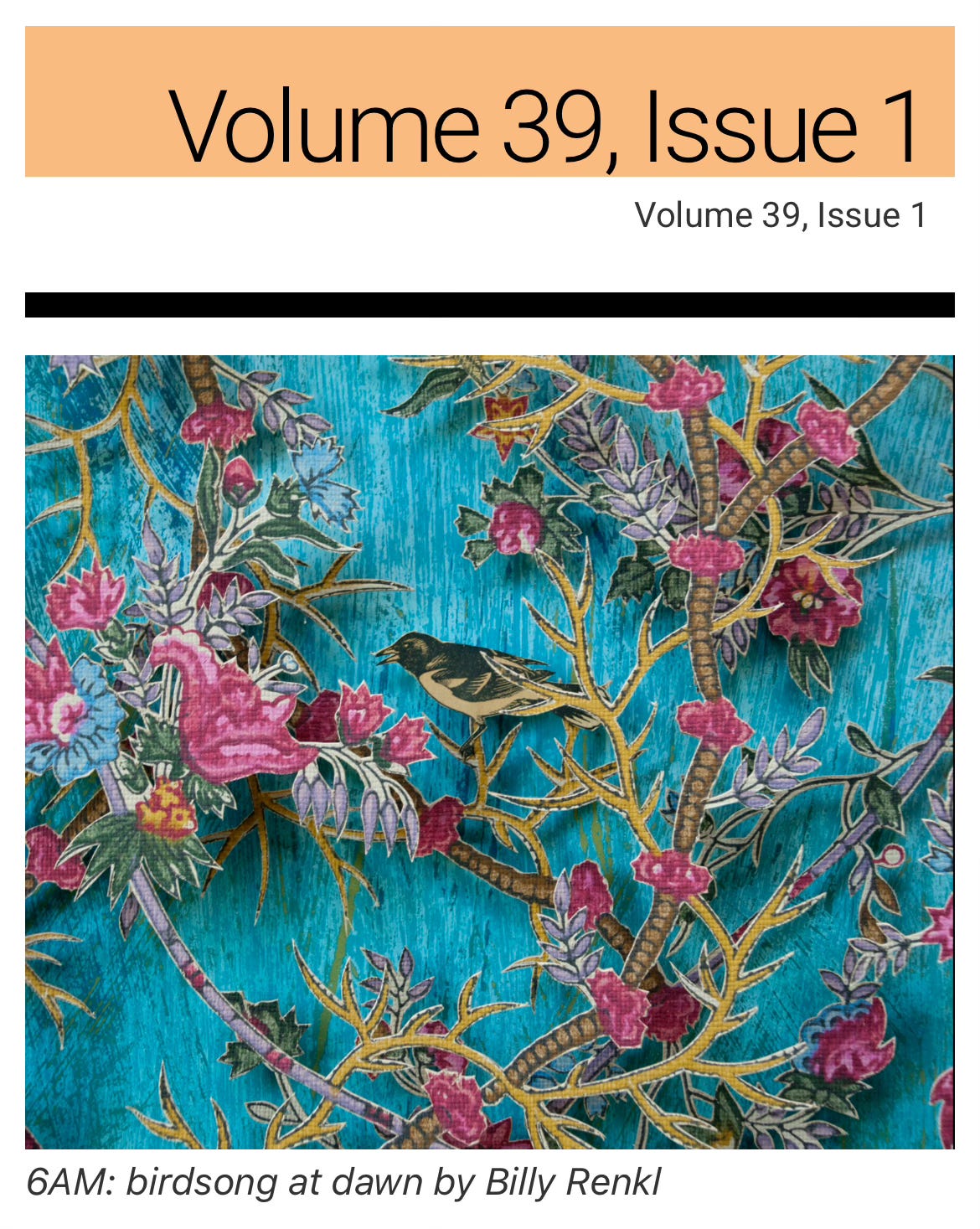
Zone 3 is digital and print, welcoming submissions of nonfiction, fiction, and poetry. Senior editor Amy Wright notes that she prizes “range—of form and perspective and most enjoys when threads of insight cross like throughways between,” and she imagines “the journal as a kind of agile vehicle capable of bouncing into wilderness areas, across farms and prairies, into the suburbs, and coming up to speed around urban centers.” The online journal is colorful and dynamic, with “cover” artworks, and images of authors and books in their News & Events section. Zone 3 is now a press, as well, with a first book award for poetry and a biennial creative nonfiction book award, each with $1,000 prize, publication, and a reading at the university. Both awards are on hiatus as the editors catch up with reading and train their new managing editor.
I’m reading through the current issue, vol. 39, issue 1. R. S. Deeren and Amy Wright are senior editors. Wright is also the nonfiction editor, and Deeren, the fiction editor. Stephanie Dugger is the poetry editor. Let’s begin with the poems, almost all of which appear as if typed on paper, in lettering that is different from the stories and essays.
“Little Silences” by Morgan Hamill is an inquisitive poem that suspects its answers, a what if narrative, and healing poem, closely observed, imagistic, and spread across the page. Writing about her body, Hamill quiets the field of herself, turns off the motor, and beckons the horses that are the little silences, her pain that may possibly have become endurable. “Observations of Vessel Activity” by Grace Mathews is a poem that details how a job is done, while the poet observes and connects other activity and ideas, and it has two equal sized stanzas. It’s a narrative instructive poem, an approach that’s gradually been gaining traction on the literary road. It works best when what we are learning how to do is only part of the poem: A night job checking the oil tankers and cargo ships amid bioluminescent organisms, while sailing on the only wind powered vessel to be seen at night, Mathews describes it all in a lyrical compact of stark metal and fluid nature, with concern for what is wrought by humans, and run without them. She is in the MFA program at San Diego State University.
The what-if in Hamill’s poem is like a flip side to the how-to in Mathews’, because in positing the questions, she tells us how she might be able to cope. Maybe you have poems that fit these interest. Both poets present a quiet scene that is huge. So does Amy Bagwell in her short poem “date/truck/gunrack”. Everything at Zone 3 has a setting, indoors or out, in mind or real. There are several poems in this issue that approach medical, health or pain subjects in different ways. Hamill has a second poem “Pre-op, 5:30 A.M.” You might also read “In the Post-Acute Care Unit of Mount Carmel Hospital in Haifa, Israel” by Anna Abraham Gassaway, and “Orpheus Waits in the ICU” by Adam Grabowski.
Story interests run off the beaten path: fabulist, fantastic, futuristic, allegorical, unusual, judging by all six stories in this issue. Each approach offers the writer a way to speak of societal issues. Let’s start with “The Light in America” by Genevieve Abravanel, a time travel story focused on the return to present, as the lead researcher tries to define for the statistician—a woman who loves him—how America was different in the future, and why he needed to return. The sunlight did not expose him there, in a different America, where people did not elect the wrong president. “It fell on me differently.” And she cannot raise the millions to return him, because of who he is in present daylight: a black man in DC. It’s largely a story in dialogue, with the characters presented through speech, as they walk along a rainy street strewn with autumn leaves, making language the dominant element. There is also the highlight of words unspoken, and hesitancy to interrupt. The rain is another language, obscuring the sun in a present the researcher Henry, doesn’t want.
“Mermaid” by Frank Reilly manages to present a different take on the fable of a half woman, half fish coming to shore. This one has hairy legs and fish head, which scares away everyone, even the predators. She’s lonely until she meets someone who understands her: a duck-billed platypus. There’s a mutual attraction, impregnation. Reilly’s language has an underlying playfulness, and a registering of animal behavior and intellectual thought to the scenes. The doubling of species in the story has a familiar counterpart in contemporary society, and there’s this wish near the end: “If her child is every creature joined, maybe every creature will see itself reflected?”
Each story has an element of exposure and longing, and a strength in being together, even if briefly. You might also like to read “Spontaneous Combustion Goes to College” by Brett Biebel, and “Raptors in the Later Age” by Bryn Agnew.
There are five pieces of nonfiction in this issue. I’m starting with “A Forager’s Guide to Love” by Heather Hawk, a weave of before and after of marriage and divorce, with references made to Samuel Thayer’s The Forager’s Harvest. Hawk forages edible plants, following the rules of care that her wilderness guide husband once ignored to his detriment, and ponders the way that neither one of them listened to her. She wishes there was a Thayer’s Guide to choosing lovers. The ramps become the metaphor for the way she should have triple checked her own feelings about marrying him, and listened to her body that grew pregnant with a uterine fibroid before she learned of his infidelity. This essay is rich with place and theme, and the sentences are detailed and direct, rather than poetic, though the whole first paragraph is a metaphor for her transformation to someone who knows who she is and what she’s doing.
A flash essay on perspective, chance, and lurking danger, “Roadside Markers” by Nicole Zimmerman, is also written in direct sentences that are structured with a bit of poetics, such as the refrain spoken by the man in the orange vest: “Another morning,” he says, nodding. “Each day is different”. And the ewe with one living and one dead lamb in the field near the roadside marker for a dead young girl that turns out to be the sister of Zimmerman’s 4th grade classmate. The refrain of man in orange vest and the woman walking her dog.
There’s also the essay “Recipe for Helga” by Madeleine Zadik, using a non-literary form (recipe) to narrate events, what’s known as “hermit crab” (named after the crustacean that uses a discarded shell for shelter). You are probably all familiar with that term already. I’ve only been familiar with the approach, not the nomenclature, such as Amy Newman’s poetry collection Dear Editor. Each of the other two essays are worth a read, too.
Thanks for reading, and subscribing to What Where, my readers. Do you think you’ve got something for Zone 3? They are a paying market, though how much is not indicated. The journal will re-open for submissions on August 15th and close on November 1st, so you do have time to consider it.
Thanks for the shoutout, Amy :) Subscribed.